
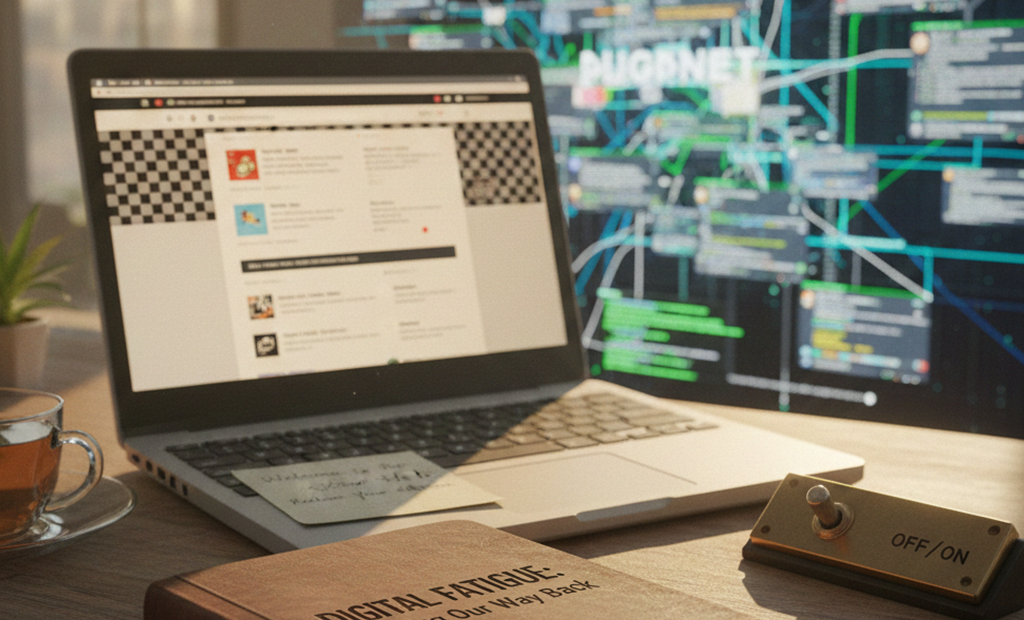
There was a time when the internet had an “off” switch.
You didn’t carry it in your pocket, buzzing against your thigh with the demands of a thousand strangers. You visited the web; you didn’t live inside it. It was a destination, a collection of quiet corners and idiosyncratic personal homepages that looked like digital scrapbooks.
Today, the web feels like a crowded room where everyone is shouting to be heard over an algorithm that only rewards the loudest voice. We are exhausted by the “Fast Web”: the world of endless subscriptions, AI-generated filler, and the frantic pace of the feed.
What is Digital Fatigue?
This blog is an exploration of the antidote. Navigation of the “Slow Web” isn’t about being a Luddite or hating technology; it’s about reclaiming our attention. It’s about returning to a web that is:
1. Hand-Curated: Prioritizing human recommendations over machine learning.
2. Static and Stable: Valuing content that doesn’t disappear or change the moment you refresh the page.
3. Ownership-Based: Moving away from “Software as a Service” and back toward tools and spaces we actually control.
The Slow Web is still there, humming beneath the surface of the modern internet. It’s in the RSS feeds, the independent blogs, the small directories, and the decentralized protocols.
We don’t have to accept the fatigue. We can choose to slow down.
Welcome to Digital Fatigue. Let’s find our way back to the quiet web, together.