
In today’s digital landscape, we’ve traded ownership for convenience, creating a state of perpetual digital insecurity. Our “purchases” are now temporary permissions that can vanish instantly.
My personal experience illustrates this: After years of building a digital Beatles music collection, a simple account transfer erased everything I’d paid for. I bought the catalog on iTunes, moved to Japan in 2017 (where it transferred fine), but upon moving back to Mexico and re-syncing, the collection was gone. Unlike physical CDs that would travel anywhere in a suitcase, cloud-based content is a fragile, revocable privilege.
The Rental Trap
This “shifting sand” creates constant cognitive load through disappearing features and devices dependent on corporate servers. If you can’t repair it, or if it won’t work without a server connection, you don’t really own it.
Hardware Vanishes Into the Cloud
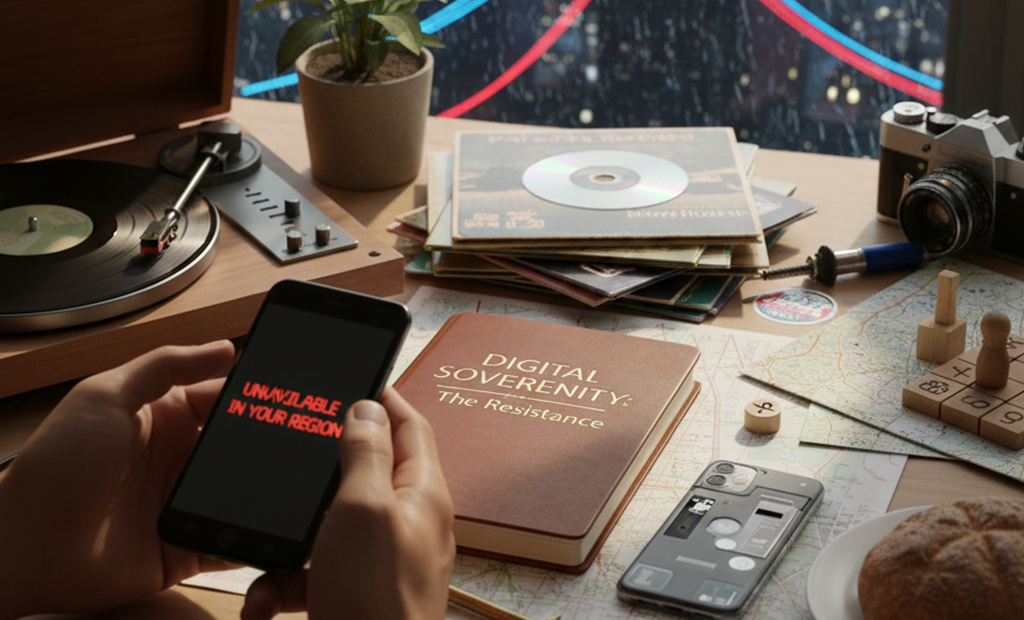
The assault on ownership extends to our devices. Your “smart” TV is a terminal that manufacturers can brick by ending support. Even “offline” features are a lie. I once downloaded a library of cartoons for my kids for a trip. Despite having “downloaded” them all, the platform only allowed six to play once we were offline. Because we crossed a border, the licensing changed, and the files I “owned” were suddenly “unavailable in this country.”
What is the point of the internet if the rules are designed to fail you exactly when you need them most?
The Sovereignty Solution
We must reclaim the “Owner” mindset:
- Local-first software: Saving files in open formats (.txt, .flac).
- Physical or DRM-free media: Buying what cannot be deleted remotely.
- Support “Right to Repair”: Choosing hardware that respects your autonomy.
This isn’t progress—it’s digital feudalism. The only resistance is to hold onto ownership wherever possible and demand that “buying” means actually owning once again.
The exhaustion you feel isn’t accidental—it’s the weight of constantly defending what should already be yours. Every disappeared album, every bricked device, every “unavailable in your region” message is a reminder that you’re no longer a customer, but a tenant at the mercy of corporate landlords. The promise of the digital age was liberation through technology, but we’ve instead built a system where our memories, tools, and creative works exist only as long as someone else profits from their existence.
The path forward requires both individual action and collective demand. Choose ownership when you can. Support companies and platforms that respect your autonomy. And most importantly, refuse to accept that this extractive model is inevitable. The future of digital life doesn’t have to be one where we own nothing—but reclaiming it requires us to remember what ownership meant in the first place: the right to keep, to repair, to share, and to pass on what we’ve paid for. Until “buy now” means what it says, our exhaustion will only deepen.